considering attach-ability (#2)

hi guys,

So, I’ve had an idea for you both for around 6 months now and have regrettably failed to share it in a robust form. I would like to do so now. 

We may thank Brad Walrond for texting with me overnight (why he was awake, I do not know:).  Jonathan, Brad archives Pony’s work and/or that of his house.

Jonathan, remember when I mentioned I wanted to talk to you on insta the other day. Well, maybe we can do that in person on February 9th. I want to invite you to a performance at the home of Livia Alexander. It is rumored that Brad will perform there/then. Pony, you are most welcome also. 

Read More
Luv Letter, # complicated

A guy from Mexico contracted HIV. We had condomless sex. I remember this well. Some four years after our hook-up he contacted me because of Luv ’til it Hurts. He wanted to catch up. He wanted to know when I contracted HIV. He needed to dispel an idea that maybe he had carried HIV since the night of our lovemaking. I needed to react with annoyance. I did not. I needed to allow this. Also. It seemed. I had allowed it before in fact. This inquisition into memory and desire and night and sex and lovemaking. It was in a graveyard, a detail I should probably leave out.

Read More

what's the connection between Luv & CHAOS?

Hi Deza,

Luv ’til it Hurts is a two-year project focused on HIV and Stigma. CHAOS is a campaign about mental health. As a person who has a chronic mental health condition as well as HIV, it is easy for me to consider and ‘internalize’ how my mental state and HIV ‘get along’ within me. As an artist who makes public, multi-stakeholder projects, I would like to ’externalize’ a range of topics that pertain to HIV and stigma. I am using my own experience to ask how others contend with the two ‘co-morbidities’ (as the doctors call them) of HIV and depression. 

Read More

Venezuela, Bogotá

Luciérnagas Laboratorio: Arte | fronteras | VIH  proyecto de arte por Daniel Santiago Salguero

Querido Todd. Respondiendo a tus preguntas del último correo te cuento: Efectivamente la crisis Venezolana ha traído una cantidad inmensa de personas de Venezuela a Colombia. Es la migración interna más grande en la historia reciente de Sur América. Se habla de hasta cuatro millones de venezolanos que están ahora en Colombia. Esto ha transformando el territorio cultural. Han llegado a asentarse en todas las ciudades de Colombia, inclusive en las islas del Caribe o en territorios rurales distantes de las ciudades. Muchos vinieron en una primera ola, quizás donde hubo más oportunidades o eran personas con preparación profesional. Ahora no es así, vienen las personas más pobres y en las situaciones más difíciles. Vienen inclusive hasta Bogotá caminando desde Venezuela. Atraviesan páramos y se enfrentan con la actitud xenófoba de muchos colombianos que no toleran su situación. No recuerdan por ejemplo que fueron los colombianos lo que emigraron a Venezuela en nuestra crisis económica y de violencia en los años noventas. Se dice que han regresado más de 300.000 colombianos que vivían en Venezuela. También se dice que la situación acá para los Venezolanos está tan difícil que muchos se están regresando a su país, se dice que se ven personas caminando por las carreteras hacia Colombia y otras ya regresandose a Venezuela. La relación específica y que interesa con respecto al VIH es que en Venezuela ya no hay medicinas para atender el virus. Así que quienes tienen VIH en Venezuela deben salir del país en una situación aún más vulnerable que las de los otros migrantes. Deben además de buscar techo, trabajo, arraigo, buscar su medicina, que es muy costosa y que el gobierno colombiano solo suministra a personas nacidas en el país a través del sistema de salud público. La situación está desbordada por muchos lados. Por ejemplo hasta la semana pasada se dio nacionalidad colombiana a más de 24.000 niños que habían nacido de padres venezolanos en territorio colombiano y que hasta ahora no tenían nacionalidad, ya que los consulados venezolanos están cerrados o no existen mas. Cómo vez, son muchas las aristas y hechos por analizar en medio de la debacle. Se dice que esto traerá muchos cambios sociales, y culturales, como se ha visto que ha sucedido en las grandes migraciones a nivel mundial y local. Ayer oí en la radio, están entrando alrededor de cincuenta mil venezolanos diariamente por la frontera a Colombia. A través del laboratorio estamos desentrañado estas historias, informaciones, estadísticas, subjetividades. Entender y encontrar información nos ayuda a situarnos en el territorio que habitamos. Desde el laboratorio intentaremos dar voz y espacio para reflexionar sobre estas urgentes temáticas.

Read More

Embroidery and curating non-artists

photo: Cadu Oliveira

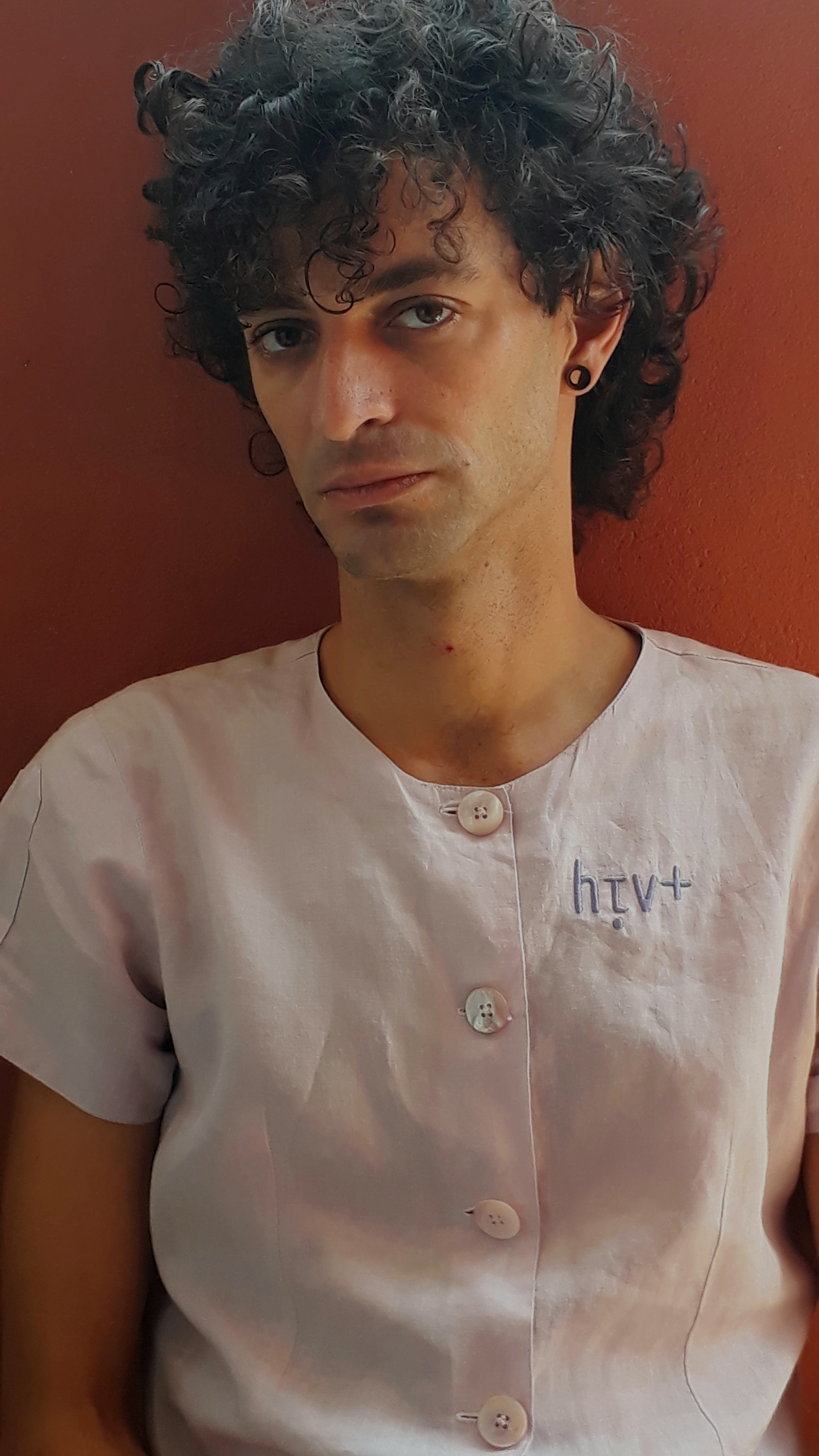
My upstairs neighbor, Carué is a medical doctor and AIDS activist. While he doesn’t front as artist, he has a cool project (that occurs to me as artistic) by which he asks for a piece of clothing. He takes it to a local shopping mall, Galeria do Rock where a lot of young people hang out in the center of São Paulo and a specific embroidery shop in the busy arcade. He pays for ‘HIV+’ to be embroidered somewhere prominently on the piece. He then tells you where to pick it up. One need not be HIV+ to receive this gift. Recently I asked him if I could include a photograph of his embroidered work in a museum show that I’m co-curating. For a range of reasons, the curatorial group first used a cropped image of his suit coat without his face, and agreed that I would ask him if he preferred a different image. Carué insisted that we show his face, and so we replaced the ‘suit coat’ with a new image he provided. It was an easy decision to come to, perhaps because we have already acknowledged both the need to personalize (or put a face to HIV) against the subtext of using the face of a white man for this particular theme (and in the Museum of Sexual Diversity’s location in a busy metro station). Since these topics were already ‘on the table’, the curatorial group was able to easily balance the topic of HIV/AIDS with other themes; reconsider the prominence and placement of non-white faces and voices in the small space; and adjust the ratio of women, men, trans (men and women), and non-binary folks participating in the show. As a curator, artist and HIV+ downstairs neighbor, I found it a unique learning experience. And, I also understood why Carué required me to pick up my gift, when the lady at the embroidery shop asked me to repeat more loudly what was embroidered on the piece as she shuffled through past orders in the back of the shop. ‘HIV+’ I said, and tipped my head to the guy behind me in line who was waiting on us to finish the transaction. She found it, holding up a green linen button-up with fluorescent orange embroidery.

Letter Report

Hi all this is a report that the musician that worked with me producing and thinking the music of my last completed worked named “Fantasia casi soneto después de una lectura de dan(c)e” sent me after going to ArteBA Focus (version of the big art fair in Buenos Aires done by the same people):

Hi, Dudu, how’s it going?

I was on ArteBA Focus for a while, all right. I give you a brief report: The work was in a plasma TV of acceptable size, but had no headphones, and the environment was too noisy to be heard well with the speakers of the device. Also, when I went, the video had a jump, a line of slight horizontal digital noise, which appeared cyclically and affected everything, video and audio. Still, it could be said that, given the context, the work was “intelligible”, and in fact, I saw several people stop to look at it for a while. Very good photos of you too, I liked them.

Read More